Damallsvenskan 2026 Predictions — 1 Million Simulations
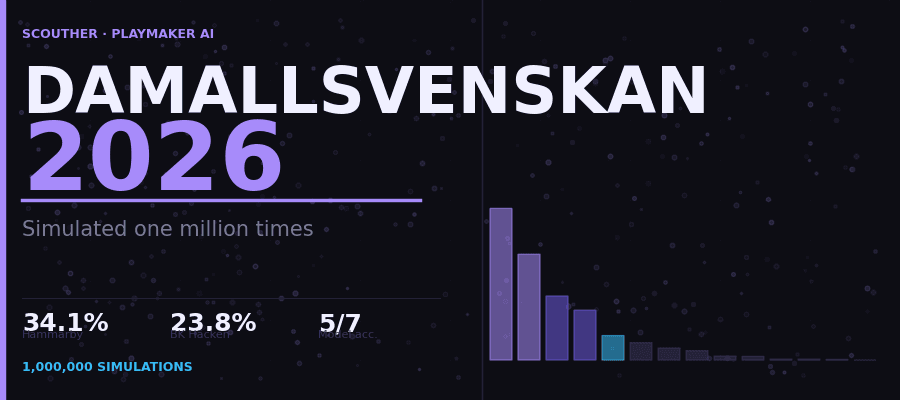
Can Malmö FF win their first ever Damallsvenskan title? The model gives them a real shot — but it actually puts Hammarby at the top. We ran one million simulations of Damallsvenskan 2026 using the same machine learning model we apply to men's football worldwide: trained on expected goals, pressing data, possession and squad values across more than 90 leagues. The result is a league with a clear top tier — and an unmistakable pattern in what type of football wins.
Hammarby favourites — despite Häcken being champions
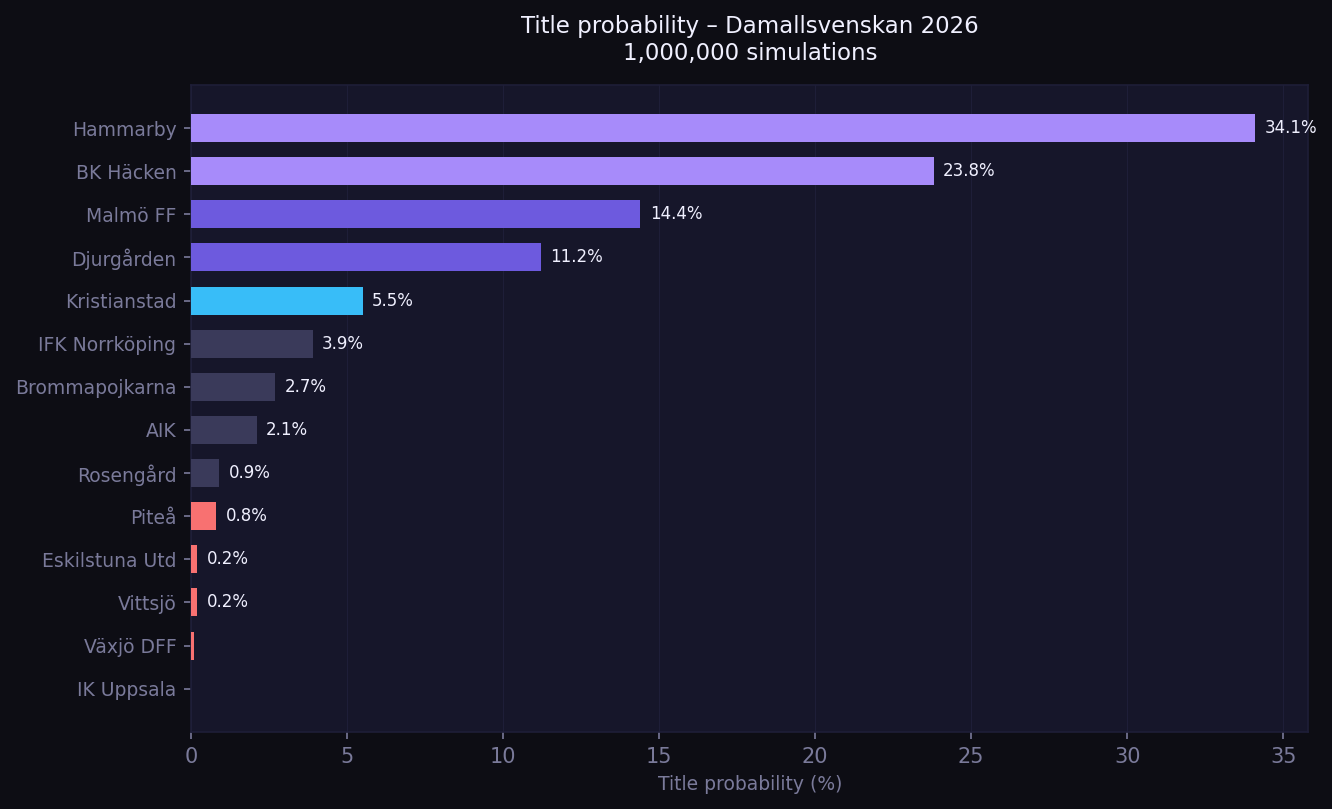
Hammarby top the simulations with a 34.1% title probability, ahead of reigning champions BK Häcken at 23.8%. What pushes Hammarby past Häcken? Possession. Hammarby's 66.0% ball possession from 2025 is by far the highest figure in the league. Häcken respond with better defensive numbers (xGA 0.84 vs Hammarby's 0.90) and higher xG (2.25 vs 2.17), but the model weights Hammarby's total dominance heavily.
The top four — Hammarby, Häcken, Malmö FF and Djurgården — account for 83.5% of all simulated title wins. That is a markedly higher concentration than men's Allsvenskan, where the top four hold 66.8%. Damallsvenskan has a clearer hierarchy.
The result – 1,000,000 simulations
| # | Team | Prev. | Exp. pos | 80% CI | Wins | P(Title) | P(Top 3) | P(Bot 3) |
|---|---|---|---|---|---|---|---|---|
| 1 | Hammarby | 2 | 2.8 | 2–10 | 341,221 | 34.1% | 72.5% | 0.6% |
| 2 | BK Häcken | 1 | 3.4 | 2–10 | 238,206 | 23.8% | 62.0% | 1.0% |
| 3 | Malmö FF | 3 | 4.4 | 3–11 | 143,885 | 14.4% | 46.6% | 2.6% |
| 4 | Djurgården | 4 | 5.4 | 3–13 | 112,292 | 11.2% | 36.1% | 7.3% |
| 5 | Kristianstad | 6 | 7.0 | 4–14 | 54,641 | 5.5% | 21.1% | 15.1% |
| 6 | IFK Norrköping | 5 | 6.3 | 6–12 | 38,569 | 3.9% | 20.2% | 7.4% |
| 7 | Brommapojkarna | 12 | 8.0 | 5–14 | 26,726 | 2.7% | 12.7% | 20.6% |
| 8 | AIK | 8 | 8.3 | 5–14 | 21,204 | 2.1% | 10.5% | 23.4% |
| 9 | Rosengård | 11 | 8.8 | 6–14 | 9,471 | 0.9% | 6.4% | 25.8% |
| 10 | Piteå | 9 | 9.3 | 6–14 | 7,910 | 0.8% | 5.3% | 30.6% |
| 11 | Eskilstuna United | 13 | 10.0 | 7–14 | 2,185 | 0.2% | 2.3% | 36.8% |
| 12 | Vittsjö | 7 | 9.9 | 7–14 | 2,154 | 0.2% | 2.3% | 36.0% |
| 13 | Växjö DFF | 10 | 10.6 | 7–14 | 1,128 | 0.1% | 1.4% | 44.8% |
| 14 | IK Uppsala | 14 | 10.9 | 8–14 | 408 | 0.0% | 0.7% | 48.1% |
Playing style is everything
The pattern is striking. All four top teams carry the avatar Possession & High Press — teams that dominate the ball and press high up the pitch. Djurgården in fourth are classified as Possession Control. Among the bottom clubs you find Low Defence & Direct (Vittsjö, Piteå, AIK) and Counter Attack & Crosses (Växjö, Brommapojkarna).
Not a single team in the top four fails to control the ball. In a league with 14 teams and a long season, that becomes decisive: teams that can dictate tempo and press the opposition's build-up do not win every match, but they win seasons. The model's feature importance analysis confirms it — xG differential and possession are the two strongest predictors by a clear margin.
The promoted sides: tough but not impossible
Eskilstuna United and IK Uppsala, both promoted from Elitettan, land in 11th and 14th respectively. Their KPIs are set using default values corresponding to the bottom of Damallsvenskan — realistic for newly promoted sides with no top-flight data to pull from. Eskilstuna have a 2.3% top-three chance. Not zero — but it requires a lot to fall into place. Uppsala, carrying the weakest KPIs, have a 48.1% probability of finishing in the bottom three. The promoted sides' fate will be determined by how quickly they can adapt to a league where possession is everything.
Rosengård – a club in freefall?
The most striking result: FC Rosengård, historically Damallsvenskan's most successful club, rank ninth with just 0.9% title probability. Their xG90 of 1.00 and possession of 49.4% — despite carrying the Possession & High Press avatar — suggest a team that wants to play high-press football but no longer has the quality to execute it consistently. A 25.8% chance of finishing in the bottom three. The gap between the avatar and the underlying numbers is a warning sign.
How the model works
The model is trained on data from over 90 leagues globally — men's and women's football share the same model, since the underlying performance KPIs are universal. We use Damallsvenskan 2025 data as the base, apply the same avatar classification and run one million simulations using truncated normal distributions fitted to three quantile models (10th, 50th and 90th percentile). One notable difference from the men's simulation: no cup data is available for women's football, so the model relies entirely on league performance from last season.
On accuracy: in temporal cross-validation across multiple leagues and seasons, the model averages a Spearman correlation of 0.49 between predicted and actual final league tables. Random guessing lands at 0. For what it is worth — a purely data-driven prediction before a ball has been kicked — that is a meaningful signal.